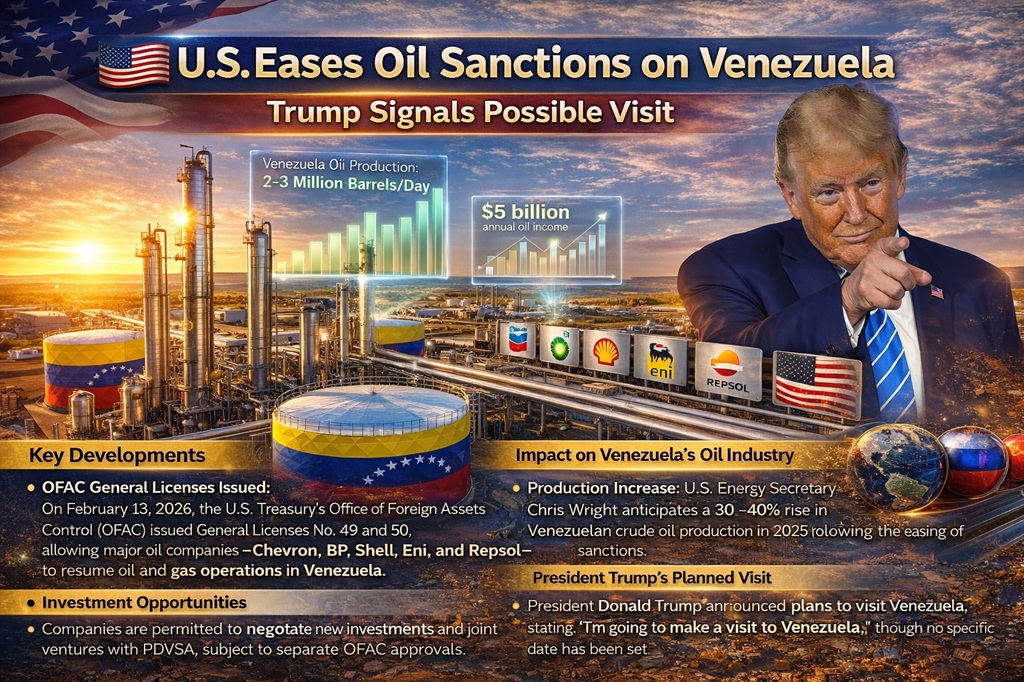
WASHINGTON: The United States has relaxed key oil sanctions on Venezuela, with President Donald Trump indicating that he intends to visit the country, though no date has yet been confirmed. The announcement comes as Washington moves to reopen Venezuela’s energy sector to major international players.
The US Treasury’s Office of Foreign Assets Control (OFAC) has issued broad licences allowing five global energy companies — BP, Chevron, Eni, Repsol, and Shell — to resume selected oil and gas activities in Venezuela under specified conditions. The move marks a significant shift in US policy toward the resource-rich South American nation.
Under the new framework, royalties from Venezuelan oil and gas projects must be deposited into accounts approved by the US Treasury, reflecting Washington’s intention to oversee financial flows linked to the country’s energy assets.
Industry observers note that while energy firms are eager to re-enter Venezuela due to its vast petroleum reserves, long-term investment will depend on regulatory clarity, particularly following past nationalisations that unsettled foreign investors.
A separate licence also permits companies to begin negotiating potential investment agreements, although participation by entities linked to countries such as China, Iran, and Russia remains restricted.
In a statement, the Trump administration described the licences as an effort to accelerate the reopening of Venezuela’s oil industry while encouraging responsible investment and supporting economic recovery. US officials maintain that the strategy is aimed at improving stability and prosperity for both Venezuelans and Americans.
Meanwhile, the State Department confirmed the delivery of more than six tonnes of medical supplies to Venezuela, part of a broader effort to support humanitarian conditions.
High-level engagement
Earlier this week, US Energy Secretary Chris Wright travelled to Caracas — the most senior American official to do so in years — where he met interim leader Delcy Rodriguez. Washington has commended her administration for cooperating on legal reforms affecting the oil sector.
Wright suggested that the US oil embargo, in place since 2019, is effectively nearing its end and called for a substantial increase in Venezuela’s production of oil, natural gas, and electricity to boost employment, wages, and overall living standards.
Chevron welcomed the policy changes, describing the new licences and recent amendments to Venezuela’s hydrocarbons legislation as important steps toward unlocking the country’s resources and strengthening regional energy security.
Italy’s Eni said it is reviewing the opportunities created by the policy shift in consultation with US authorities, while Spain’s Repsol declined to comment.
Venezuela’s oil output reached approximately 1.2 million barrels per day in 2025, recovering from about 360,000 barrels per day in 2020, but still well below the three million barrels per day it produced roughly a quarter-century ago.